Prepare
1. According to the number of missing teeth. Location, relationship and abutment morphology, tissue structure and periodontal support tissue to select abutment and determine the number of abutments.
2. Check whether the extraction wound in the missing tooth area is healed, the size of the missing tooth space, the alveolar ridge and the oral mucosa.
3. The crown of the abutment tooth should be tall and the root should grow long. If there is a tooth or periodontal disease, treatment should be done first. The pulpless tooth should undergo complete root canal treatment.
4. The occlusal relationship should be basically normal. If the abutment teeth are tilted and displaced, the opposing teeth are elongated, twisted or dislocated, the grinding must be adjusted or the design method of the retainer must be changed.
method
l. Abutment tooth preparation: referring to the restoration of tooth defect, when preparing the tooth according to the type of retainer, it is required that the corresponding axial surfaces of all abutments are parallel to each other, without undercuts or slightly oriented towards the square or incisal end polymerization 2o-5o, In order to obtain the common seating path of each retainer, attention should be paid to enhancing the retention force of the retainer.
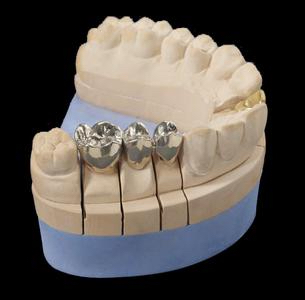
2. Impression and filling: It is required that the impression must be accurate, complete and clear. For casting fixed bridges and metal-porcelain bridges, double-layer silicone rubber impressions are used to take full dental impressions, anhydrite is used to fill the molds, and then a substitute needle is used to form a removable model.
3. Fixed bridge production: generally completed in the laboratory.
4. Trial-fitting of fixed dentures: The initially polished retainer is tried on each abutment, and the retainer is required to be correctly fitted with the neck of the abutment, the edge is properly stretched, the adjoining relationship is good, and the occlusion is coordinated. If there is no warping and the retention is good, if there is any problem, it can be polished and cemented. The metal-fired porcelain bridge is tried on before glazing, and after the shape is trimmed and the occlusion is adjusted, the glazing is cemented.
5. Doctor’s advice: The patient is instructed to fast within 2 hours after cementation, not to chew hard food with a fixed bridge within 24 hours, and to make an appointment for a review if necessary.
发表回复